Prepare your OpenAPI spec
Make your OpenAPI file easier for MCP Stack to parse, safer for agents, and clearer for developers.
The OpenAPI spec is the source material for a generated MCP server. MCP Stack can work with normal OpenAPI 3.0 and 3.1 documents, but the quality of the generated tools depends on the quality of the operation names, descriptions, schemas, auth metadata, and server URLs.
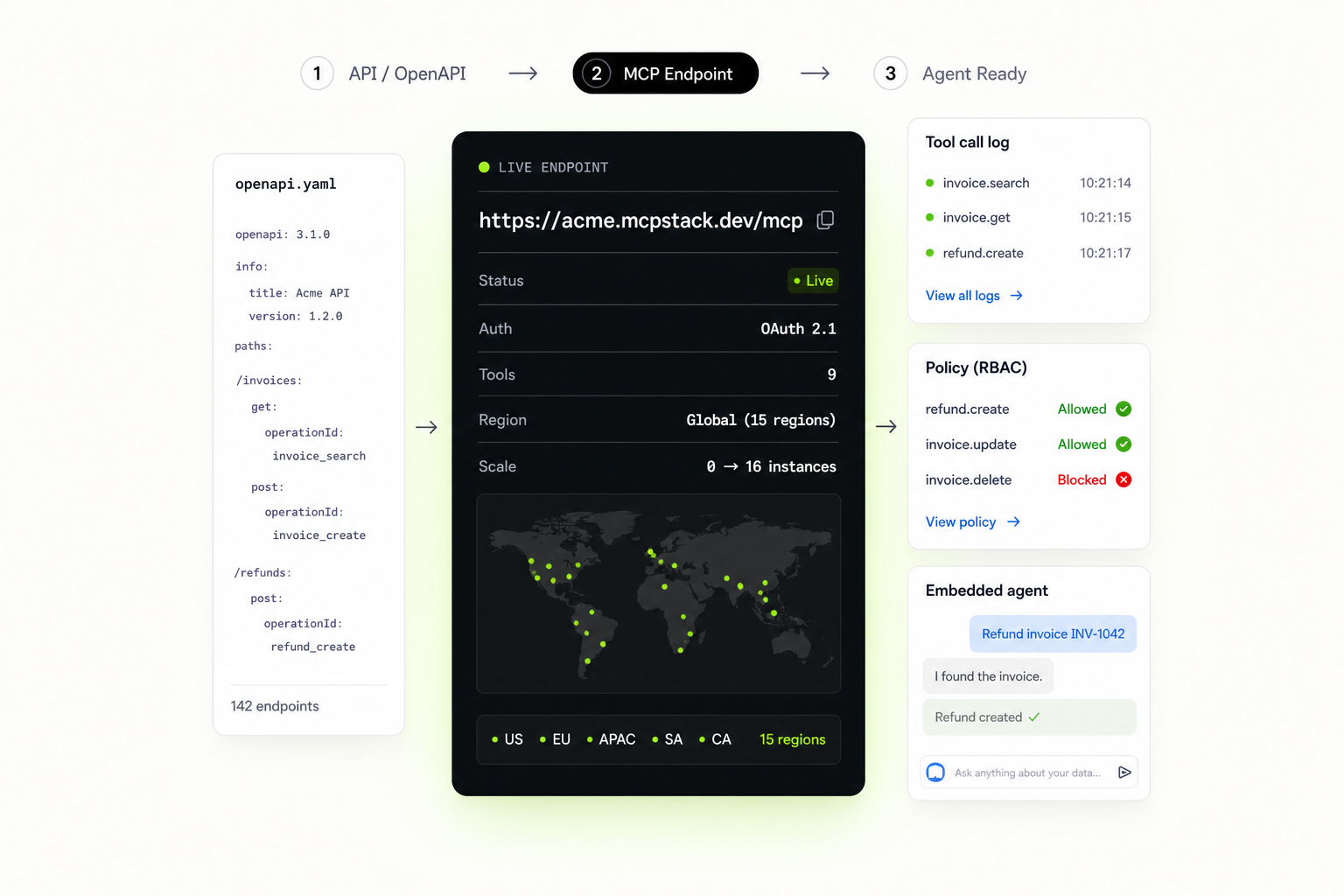
The generator reads your API contract, turns selected operations into MCP tools, and keeps auth metadata available for Gateway or static runtime auth.
Have these before you start the dashboard wizard:
| Requirement | Why it matters |
|---|---|
| Public OpenAPI URL | The dashboard wizard imports specs from URLs. Use the CLI when the spec is only available as a local file. |
| OpenAPI 3.0 or 3.1 | The parser expects modern OpenAPI structure. |
Correct servers entry | Generated tools need a base URL for upstream API calls. |
Stable operationId values | These become better tool names than generated path names. |
| Request and response schemas | Agents need precise input contracts and useful result structure. |
| Security schemes | MCP Stack uses them to recommend Public API, Static Headers, or Gateway. |
Give every important operation a stable operationId, a direct summary, a practical description, and complete parameters.
paths:
  /tickets/{ticketId}/notes:
    post:
      operationId: createTicketNote
      summary: Add a note to a support ticket
      description: >
        Adds an internal note to the ticket timeline. Use this only after
        the user confirms the ticket and note content.
      tags:
        - Tickets
      parameters:
        - name: ticketId
          in: path
          required: true
          schema:
Use OpenAPI security metadata even if the API works without it in local development. MCP Stack uses this signal to recommend the right runtime auth mode.
components:
  securitySchemes:
    userOAuth:
      type: oauth2
      flows:
        authorizationCode:
          authorizationUrl: https://auth.example.com/oauth/authorize
          tokenUrl: https://auth.example.com/oauth/token
          scopes:
            tickets.read: Read tickets
            tickets.write: Update tickets
For static API keys:
components:
  securitySchemes:
    upstreamApiKey:
      type: apiKey
      in: header
name: X-API-KeyReview the spec for:
operationId values.http://localhost:3000.Default for every operation.The spec helps MCP Stack generate and describe tools, but it is not your final security boundary. Use Gateway, scopes, downstream API checks, and tool selection to keep the runtime safe.
The dashboard wizard and server settings support private specs directly. If your spec is private:
.json, .yaml, or .yml.mcpstack servers create --openapi-file ./openapi.yaml
mcpstack servers update <server-id> --openapi-file ./openapi.yamlBefore giving the server to developers or agents, check:
If the generated tools look odd, inspect the OpenAPI source first. Check the operation name, path, operationId, description, schemas, servers, and securitySchemes. Most generation quality issues start there.